
Part 1: What was life like when there was no technology?
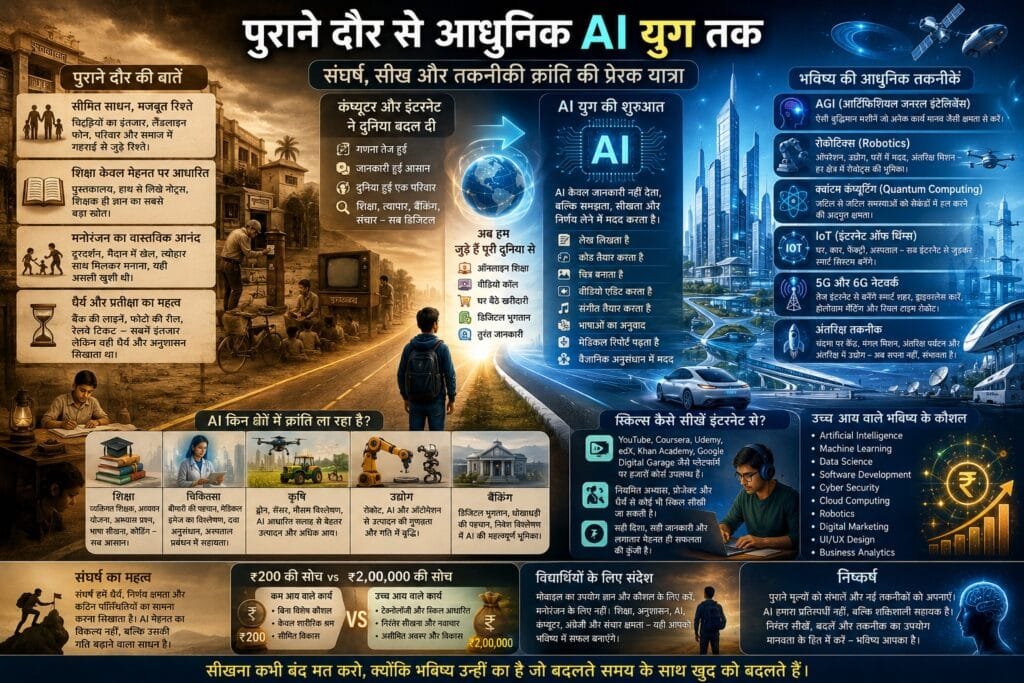
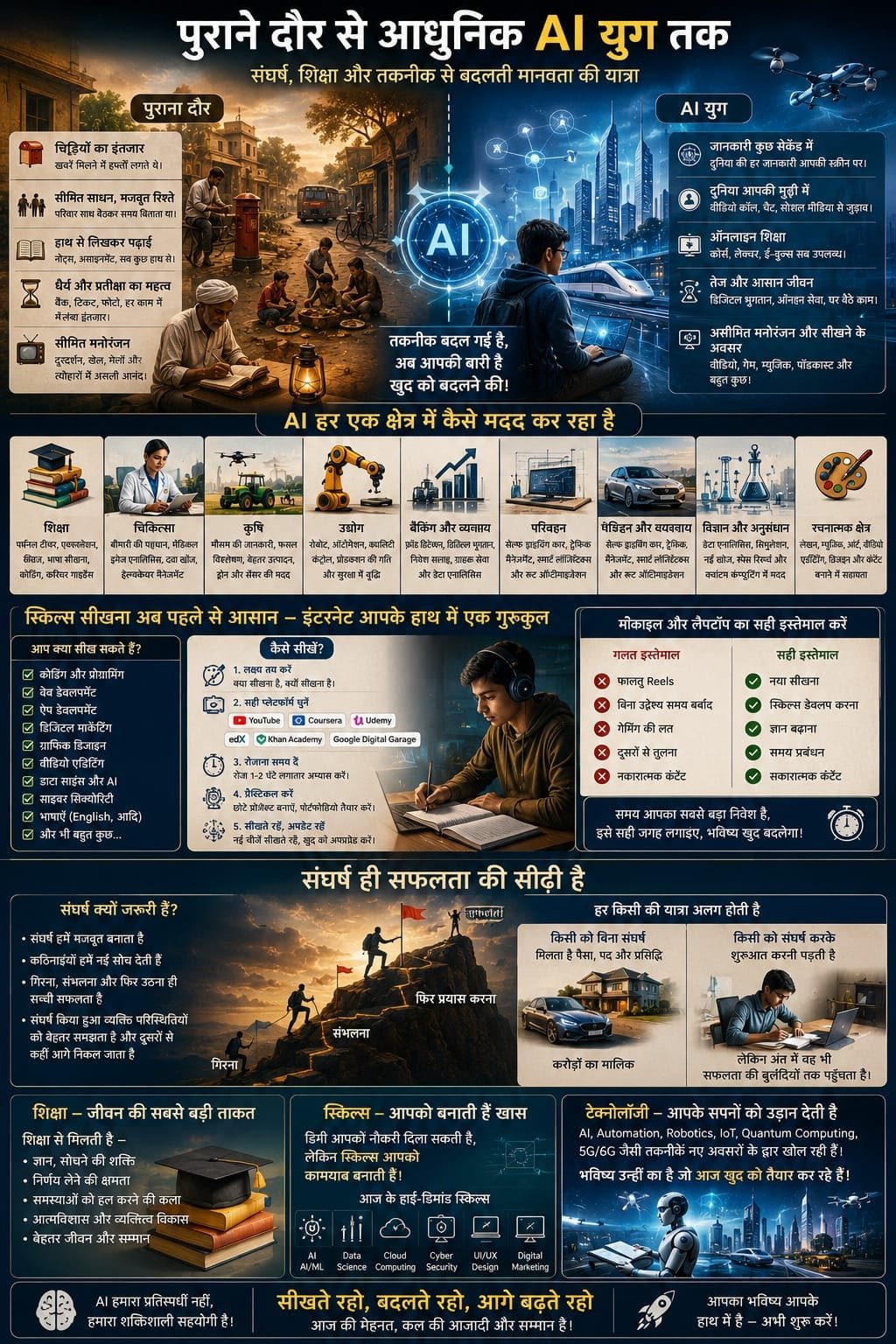
- Limited Resources, but Strong Relationships
Earlier, people didn’t have smartphones, social media, and video calls. Families ate meals together, neighbors shared each other’s joys and sorrows, and friendships were forged not just online but in real life.
- Letters were awaited for months.
- Landline phones were the entire family’s means of communication.
- Time and emotions were of paramount importance in relationships.
- Education was entirely based on hard work.
Today, thousands of books are available at the click of a button, but earlier, students had to study for hours in libraries.
- Notes were written by hand.
- Finding answers to difficult questions took days.
- Teachers were the greatest source of knowledge.
- The True Joy of Entertainment
Today, thousands of videos are available on mobile screens, but earlier, entertainment was different.
- The entire family watched programs together on Doordarshan.
- Children played cricket, kabaddi, kho-kho, gilli-danda, and marbles.
- Festivals were celebrated with the entire neighborhood.
- The Importance of Patience and Waiting
Today, every task is completed in seconds, but in the past—
- Long lines formed at the bank.
- After taking a photo, one had to wait for the reel to be washed.
- It took hours to get a railway ticket.
This very waiting developed patience, discipline, and restraint in people.
Part 2: How did computers and the Internet change the world?
At the end of the twentieth century, computers and the Internet changed the course of the entire world.
The Computer Revolution
Computers—
- Made calculations faster.
- Digitized government work.
- Increased industrial productivity.
- Gained a new impetus to education and research.
What used to take months, now took minutes.
The Internet transformed the entire world into a global family.
Today we— - Study online.
- Make video calls.
- Shop from home.
- Make digital payments.
- Instantly access any information in the world.
Part 3: The Beginning of AI and Today’s Technological Revolution
Today we have entered not just the age of computers, but the age of Artificial Intelligence.
AI is not just a technology that provides information, but also helps us learn, understand, analyze, and make decisions.
Today AI—
- Writes articles.
- Creates code.
- Creates images.
- Edits videos.
- Composes music.
- Translates languages.
- Reads medical reports.
- Assists in scientific research.
Part 4: Advanced Technologies of the Future
The world is going to change even more in the coming years.
Artificial General Intelligence (AGI)
Intelligent machines that can perform a variety of intellectual tasks with human-like capabilities.
Robotics
Robots will—
- Perform operations in hospitals.
- Increase production in industries.
- Assist in homes.
- Work on space missions.
Quantum Computing
This technology has the potential to solve extremely complex problems much faster than traditional computers.
Internet of Things (IoT)
In the future—
- Homes,
- Cars,
- Factories,
- Hospitals
will all be connected to each other via the internet.
5G and 6G Networks
In the future, internet speeds will be so high that—
- Driverless cars
- Smart cities
- Real-time robots
- Hologram meetings
could become part of normal life.
Space Technology
Humans will no longer be confined to Earth.
In the future—
- Research stations on the Moon
- Missions to Mars
- Space tourism
- Industries in space
could be possible.
Part 5: What areas is AI revolutionizing?
Education
AI can become a personal teacher for every student.
- Personalized study plans
- Instant answers
- Practice questions
- Language learning
- Coding
Everything has become more accessible than ever before.
Medicine
AI is assisting doctors.
- Early detection of disease
- Medical image analysis
- Drug research
- Hospital management
Significant progress has been made in these areas.
Agriculture
Modern farmers—
- Drones
- Sensors
- Weather